A few months ago, I started watching the job market more closely. Jobs were filling fast. Layoffs were making headlines. And one thing became impossible to ignore: having solid experience is no longer enough on its own. AI is changing how work gets done — and the smartest response is not fear. It is literacy.
In this article, I share the exact approach I used to build my own AI literacy — what worked, what made a difference, and how to fit learning into real life.
- Why AI literacy matters now, not later
- What AI literacy actually looks like in practice
- How to start building it in under 30 minutes a day
- Why this is about empowering yourself, not replacing yourself
So what is AI literacy?
AI literacy is not about becoming a coder or understanding the inner workings of every model. It is the ability to understand AI, critically evaluate it, and collaborate with it responsibly and confidently in everyday work.
It is not about mastering the tech. It is about learning how to think with it.
Mindset
AI literacy starts with curiosity over fear. The question shifts from “Will this replace me?” to “How can this support me?”
Awareness
AI is already showing up in inboxes, HR systems, CRMs, writing tools, and decision-making workflows. Knowing where it appears helps you stay in control.
Practical use
This is where it becomes real: writing better prompts, checking outputs, spotting bias or hallucinations, and folding AI into real work.
AI literacy is like learning how to use a calculator. You do not need to build it. But knowing how to use it smartly changes what you are capable of.
Why AI literacy matters now
This is not theoretical anymore. AI is already screening CVs, powering customer conversations, drafting presentations, analysing data, and writing marketing copy.
The professionals who know how to collaborate with it are moving faster, producing more, and spending less time on the tasks that burn them out.
The shift to understand
You do not need to compete with AI. You need to learn how to work with it — and use it to enhance your value.
Debunking the biggest myths
“I’m not technical.”
You do not have to be. Most AI tools are built for everyday users, not engineers.
“I’m too late.”
You are not behind. Most people are still figuring this out, including leaders.
“AI will replace me anyway.”
Not if you learn to work with it. The bigger risk is being left behind by people who know how to use it well.
What do you actually need to learn?
When I first started learning about AI, I focused on tools and prompts. But I quickly realised that real AI literacy is bigger than “using AI.” It is about impact, ethics, creativity, and responsibility.
The Open University’s Critical AI Literacy framework is a useful way to structure your learning and reflect on where to grow next.
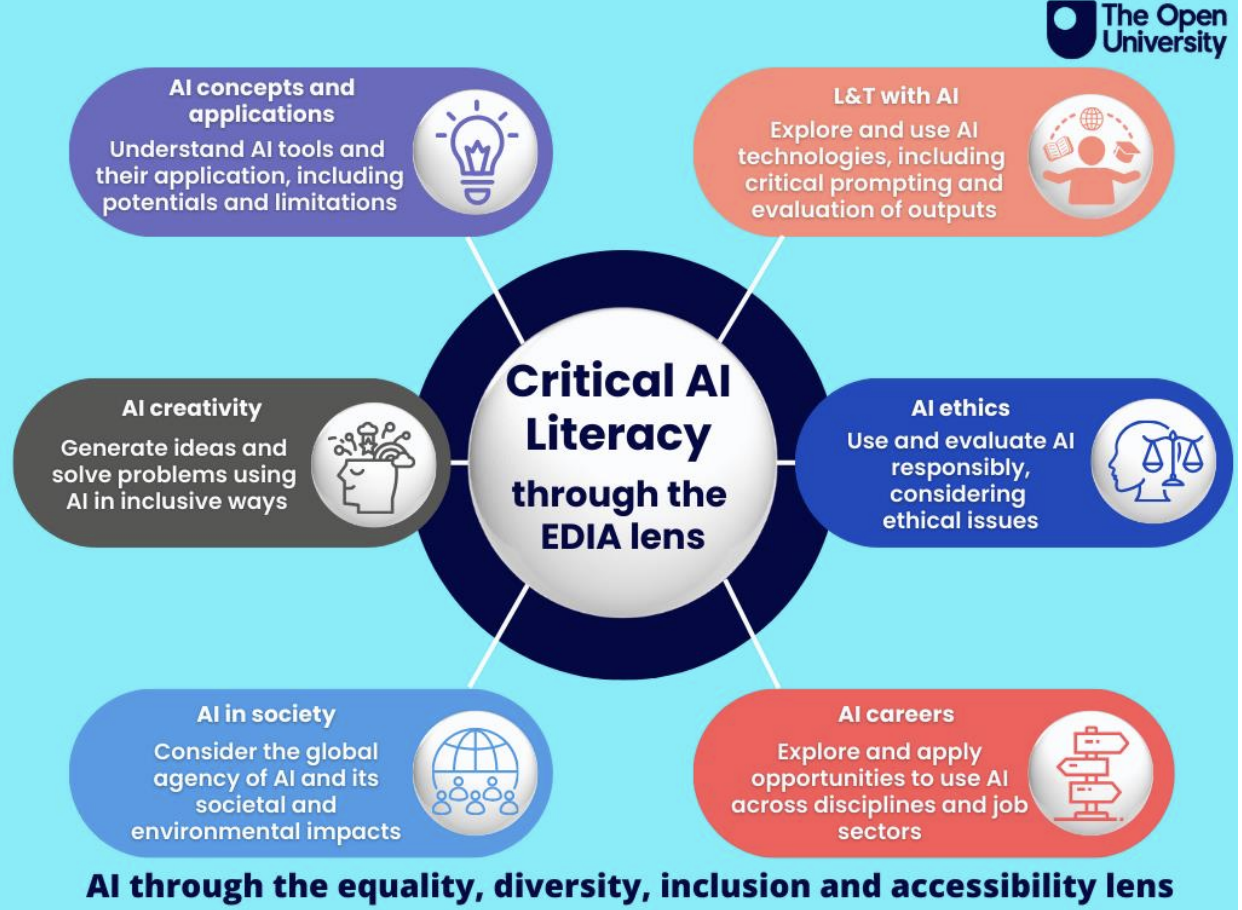
You can also link to your AI Literacy Self-Assessment Grid here as the natural next step.
How to build AI literacy in real life
You do not need a PhD, a sabbatical, or an expensive course. What you do need is curiosity, a bit of time, and a way of learning that fits around life.
Here are six things that worked for me.
Start with the basics
Learn the language first. Understanding core terms helps everything else make sense faster.
Try one tool a week
Pick a real task: email drafting, summarising notes, or brainstorming ideas. Keep it low-risk and practical.
Tip: Start with routine work, not high-stakes work.
Learn with smart people
Follow people who explain AI in plain language. Join communities. Listen to podcasts while you cook or walk.
Practice prompting
Prompting is a professional skill. Better context usually means better output.
Think of it like briefing a junior teammate, not commanding a machine.
Subscribe to something small
Stay close to the conversation without overwhelming yourself. One good newsletter or podcast is enough.
Small, regular exposure beats bingeing once a month.
Reflect by sharing
Write a short post, share a use case, or talk about what surprised you. Teaching what you learn deepens understanding.
Learning becomes more powerful when you do not keep it to yourself.
The bottom line
You do not need to become an AI expert overnight. You just need to start.
The people who start small, build smart, and stay curious are the ones who will thrive. AI literacy is not about becoming a machine. It is about staying human while learning how to use machines to your advantage.
Want to build your AI literacy deliberately?
Download the AI Literacy Self-Assessment Grid and use it to spot your strengths, identify gaps, and decide what to learn next.

About the author
I’m passionate about building Agentic AI systems that work with people, systems that enhance human creativity, reduce busywork, and actually make teams better at what they do. I believe in starting simple, building smart, and scaling collaboratively, because sustainable change doesn’t come from massive launches, it comes from useful tools people want to keep using.